“I’ve never believed love fixes us. I think love reveals us.”
Aitch Alberto is a generational director.
Truly and unapologetically herself, she has built a body of work that is both specifically intimate and universally human.
I have had the absolute privilege to sit down with her to ask a few questions about upcoming short The Long Con, the journey so far, and the values that continue to define Aitch Alberto as one of the most exciting voices in contemporary film.
Let’s fucking go.
I was first introduced to you through Aristotle and Dante Discover the Secrets of the Universe. The Long Con is quite a pivot from that. What was your inspiration for this story?
In so many ways, The Long Con feels like a reintroduction to me. I think people see Aristotle and Dante and assume that’s where my voice lives, but the truth is a little more complicated.
Ari and Dante was deeply personal. It was, in many ways, a goodbye. A goodbye to an uncomfortable and inauthentic version of myself. A goodbye to the person I had to be to survive.
But before any of that, I grew up on the run. I grew up around larger-than-life people, hustlers, dreamers, storytellers, and people reinventing themselves every few miles.
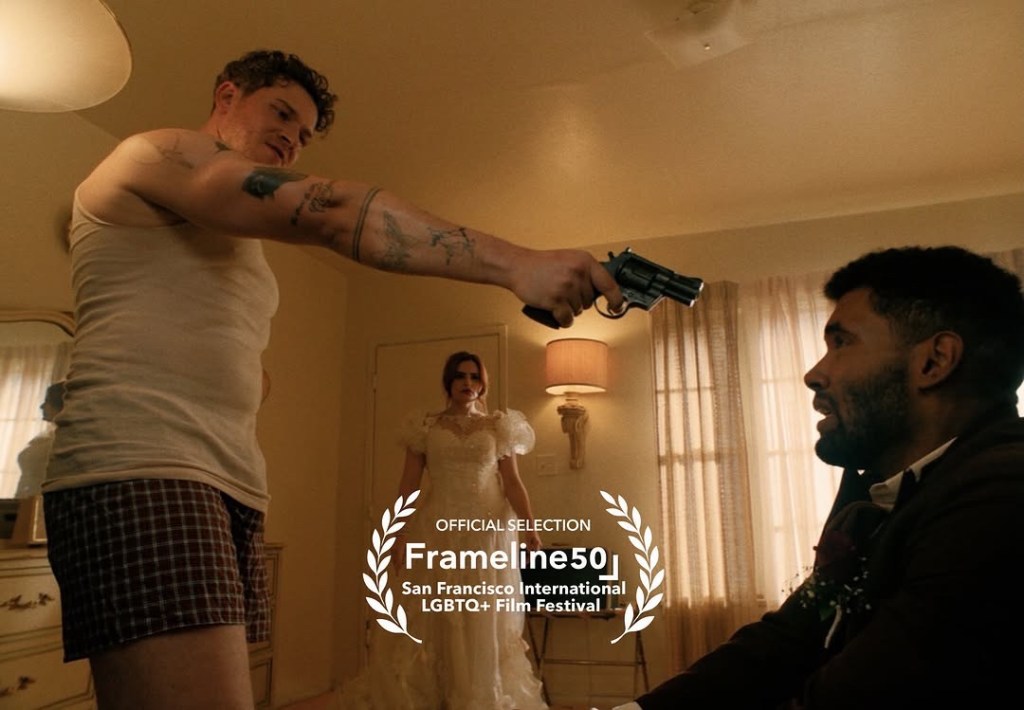
I grew up understanding that identity wasn’t fixed. It was something people built and sometimes escaped through. That’s always fascinated me. So, The Long Con feels like a return to the stories I’ve been carrying my whole life. People are searching for freedom. People trying to outrun the stories they’ve inherited. It’s a crime film on paper, but to me it’s a romance. A story about two people desperately trying to build a future while dragging their past behind them.
The casting for this is absolutely incredible. Was the pairing of Nava Mau & Oliver Stark always something you had in mind? How did they come on board?
What made the experience even more special was that so much of this production was built around people I genuinely love and admire. That’s one of the gifts of working in this industry long enough. Your collaborators become your friends. The majority of the cast and crew were my friends.
Nava was someone I deeply admired. I wrote The Bride with her in mind. She brings such intelligence, vulnerability, and power to everything she does. The Bride could easily become larger-than-life, but Nava found the humanity beneath the performance.
Oliver is a long-time friend. The Grifter needs danger, tenderness, and damage, and Oliver understood that immediately. He found the wounded heart beneath the bravado.
They are a magical pairing.
Who would you love to work with in the future, if it were guaranteed they’d say yes?
As for collaborators, I’d love to work with Jessie Reyez. I think she’s one of the most fearless storytellers working today.
Every song feels like she’s telling the truth.
I love artists who feel completely alive onscreen. People who aren’t interested in perfection.
The dream is finding collaborators who make you braver.
Something that stands out to me about your stories is that you tell real stories about real, complicated, and nuanced characters. There are no perfect love stories.
What was the first film you remember watching that influenced your perspective on love and relationships?
My Letterboxd top four are The Professional, True Romance, Badlands, and Paper Moon.
Those films probably explain me better than I can explain myself.
They’re all stories about outsiders creating their own rules, finding connection in unlikely places, and navigating the space between danger and tenderness. That’s a combination I’ve always been drawn to.
The first film that truly made me want to write, though, was Leaving Las Vegas. I was far too young to be watching it, but it was one of the first times I encountered a film that didn’t try to clean people up for the audience. It treated damaged people with compassion. It is understood that love doesn’t necessarily arrive to save us; sometimes it simply asks us to see each other clearly. That idea never left me.
The films that have stayed with me over the years aren’t really about perfect relationships. They’re about imperfect people finding one another.
I’ve never believed love fixes us. I think love reveals us.
The relationships that move me most are messy, contradictory, frustrating, and deeply human.
You’re a fellow of the Highways Lab program, which is so refreshingly diverse. What does access mean to you, and what advice would you give to young, minority filmmakers and creatives trying to break into the industry?
Access is the difference between talent being discovered and talent being overlooked. There are extraordinary artists everywhere.
What often separates the people who get opportunities from the people who don’t isn’t ability; it’s proximity.
Access means mentorship, resources, introductions, and the ability to imagine yourself in spaces that historically weren’t built for you.
My advice is simple: stop waiting for permission.
Make the short film.
Write the script.
Gather your people.
Build your community.
The people sitting beside you today may become your collaborators for the next twenty years. And don’t spend your energy trying to make something that feels industry-approved.
Make the thing only you can make.
Your specificity is your superpower.
Your storytelling shines so much light on LGBT+ stories without falling into the typical ‘kill your gays’ or angsty queer cinema tropes. Having a trans actress lead a story like this is everything and (I hope) will set a precedent for inclusion in film. How has your identity as a Trans, Cuban-American woman shaped your identity as a filmmaker?
It’s impossible to separate who I am from the work because every artist creates through their own lens.
The fact is, I’m Cuban-American. I’m trans. I’m a woman. Those things are part of me and always will be. But one of my biggest goals as a filmmaker is actually to move beyond identity being the defining characteristic of the work.
I’ve spent years fighting to see trans stories onscreen. But I also think the next evolution is allowing trans people to exist inside stories that aren’t exclusively about being trans.
I’m not interested in shrinking myself into a category that makes other people comfortable. I love disrupting spaces I’m supposedly not meant to occupy. A crime film. A fantasy film. A romance. A fairy tale. A thriller.
I was born trans. That’s the lens through which I experience the world. But my work is ultimately about being human.
I think true inclusion happens when we stop treating certain people as representatives and start allowing them to simply be characters. To be complicated. To be flawed. To be funny. To be sexy. To be heroic. To be terrible. To just be people.
Is there anyone you’d like to single out or thank as an ‘unsung hero’ of The Long Con?
The funny thing about The Long Con is that so much of the cast and crew were already people I loved, admired, or genuinely wanted to spend time with.
If I had to single out a few unsung heroes, I’d start with my editor, Jason Gallagher. He believed it and has been supportive at every step.
My music supervisor is my secret weapon. He worked on Ari and Dante, too. Music is a huge part of my writing process, and it does so much of the emotional heavy lifting, and in this, every choice felt deeply intentional.
The finale song is also its own unsung hero and felt like the missing piece. It feels ancient, but it’s not. CW Stoneking is otherworldly, and it felt like it completed my vision.
Colorist Katie Jordan is another. The desert can be beautiful, romantic, dangerous, lonely, and funny all within the same frame. She helped us build a visual language that feels uniquely ours.
Above all else, what inspires you?
Transformation.
The moment someone realizes their life can be bigger than the story they’ve been handed.
Maybe that’s because I grew up surrounded by people reinventing themselves. Maybe it’s because I’ve spent my own life becoming myself. But I’m endlessly fascinated by people who look at the role they’ve been assigned and decide to write a different ending.
Most of my work, in one way or another, is about that.
The courage to imagine another version of yourself.
And then becoming it.
What do you think will surprise viewers most when they watch The Long Con?
I think people will be surprised by how romantic it is and how it’s slightly absurd.
Yes, there are guns, desert motels, and a few bad decisions. But underneath all of that is a very tender love story.
I hope people come in expecting a crime film and leave thinking about the relationship at the center of it. Because for me, that’s always been the point.
And finally, what’s next for you?
I’m actively building several projects right now, all of them very different from one another.
One is Pixies, a dark fantasy that lives somewhere between a fairy tale and a punk fever dream. It’s probably the closest thing to the movie I would’ve obsessed over as a teenager.
I’m also developing Harlow’s, the story of Rachel Harlow, which is incredibly close to my heart. I can’t say too much yet, but we’re putting together a truly exciting cast; if you stalk my Insta, you may figure it out. I’m eager for people to see that world come to life. Especially right now, which is also what makes it a challenging project to get on its feet.
Beyond that, there are several other projects in various stages of development. What ties them all together is the same thing that has always drawn me to storytelling: outsiders, dreamers, romantics, and people in the midst of transformation. Those are the stories I’ll probably spend the rest of my life chasing.
The Long Con premiered at the Los Angeles Latino International Film Festival (LALIFF). It stars Nava Mau (Baby Reindeer, All the Words But the One) & Oliver Stark (9-1-1, Hard Tide).
There are currently no plans for online streaming, but keep an eye on Aitch Alberto’s Instagram page for screening dates and updates on future projects.

 Take Five.
Leave a comment